Custom Valley & W-Valley Flashing: Fabrication for Roofing Crews
The channel that carries the most water on the roof — and how to spec and order it so it drains fast, sheds debris and never crosses over.
A valley is where two roof planes meet and dump their runoff into a single channel, which makes it the highest-volume, highest-velocity path for water on the entire roof. Get the valley metal right and it moves that water off the roof cleanly for decades; get it wrong and it’s the first place you’ll see rust streaks, ice buildup and leaks into the deck below. This guide is written for roofing crews, GCs and exterior contractors who want valley flashing fabricated to fit the roof it serves rather than bent up from a coil on the tailgate. Send us the pitch, the length and the profile you want, and the valley comes back straight, consistent and ready to lay in.
Open valley, closed valley, and why the W matters
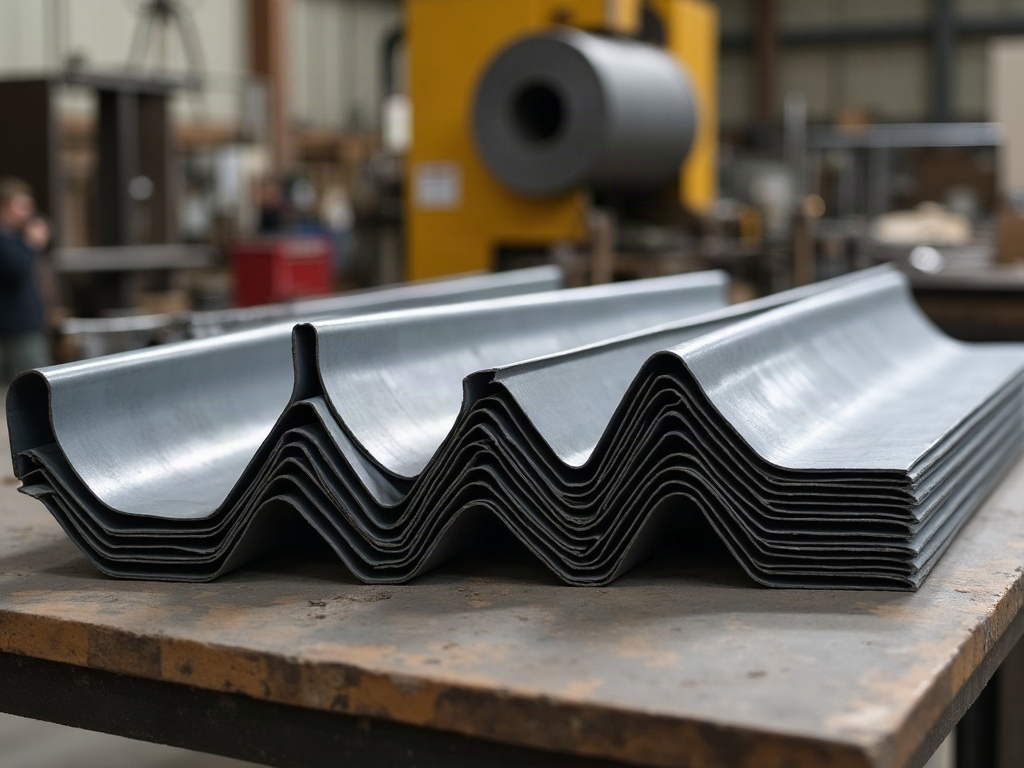
There are two broad approaches. A closed (woven or cut) valley runs the roofing material across the valley and relies on an underlayment membrane beneath — common on asphalt shingle work. An open valley leaves a formed metal channel exposed down the center, which is the standard for metal roofing and for any roof where you want the water in a defined, self-cleaning path. Within open valleys, the W-valley adds a raised rib formed down the center of the channel. That center rib is the detail that earns its keep: it stops water sheeting down one plane from shooting across the valley and driving up under the shingles or panels on the opposite side, and it stiffens the whole channel so it stays straight underfoot. Plain V-valleys, single-rib and W-profiles all have their place — tell us the roof system and we’ll form the profile that suits it.
The detail that decides performance: valley metal needs hemmed (folded-back) edges so the shingle or panel edge tucks over a safe lip instead of a raw cut edge, and enough width that the exposed channel clears leaves and snowmelt instead of damming. Give us the roof pitch and the covering — shingle, standing seam or exposed-fastener panel — and we’ll set the width, the rib and the edge hems to match.
Why custom-fabricated valley beats stock coil work
Field-bending valley on site gives you inconsistent width, wandering center lines and edges that are never quite hemmed the same twice. Custom fabrication lets you form the valley to a consistent width and profile down its whole length, add the center rib exactly where you want it, hem both edges cleanly, and get it in the substrate, gauge and finish that match the rest of the roof. On material and gauge the same logic applies as the rest of the metal package — our metal gauge guide covers where to step up for a long or high-traffic valley, and the aluminum vs. steel guide helps you pick the substrate for the climate and the roof covering.
How to spec a valley run
Valley is quotable once we know the roof and how the metal sits in it. Give us the roof pitch on both planes meeting at the valley, the total linear length of each valley, and the roof covering so we can set an appropriate exposed width and edge detail. Tell us the profile you want — plain V, single center rib or full W — and whether you want a wider channel for a snow-load or high-debris roof. Note the substrate and gauge, the finish or color, and whether valleys meet at a hip or dead-valley that needs a formed transition piece. If you’re matching existing roof metal, a photo with a tape across the valley gets us most of the way there. Turning that field measurement into a clean fabrication drawing is exactly what our guide to spec’ing custom trim & flashing walks through.
Laps, terminations and the details that leak
The straight run is the easy part; valleys fail at the top, the bottom and the laps. Where one length of valley meets the next on a long run, the upper piece must lap over the lower by enough that water can’t drive back under the joint — call out your run length and we’ll fabricate lengths that lap correctly rather than leave your crew guessing. At the eave, the valley needs to discharge cleanly into the gutter or off the edge without dumping behind the fascia; at the ridge or a dead-valley it needs a formed closure so the top is sealed. Where the valley meets a wall, it ties into counterflashing rather than being caulked to the siding. Send the terminations with the run and we’ll build the closures and transition pieces to match, so the hardest details aren’t being field-cut in the weather.
Lead time, quantities and getting it to the jobsite
Lead time depends on the total footage, the number of formed transitions and closures, and the finish. A run of straight valley in a stock color moves faster than a job with several dead-valleys and a custom Kynar color, so tell us the footage, the profile, the transition count, the finish and your need-by date up front — we’ll tell you straight whether that date is workable rather than promise it and miss. Valley ships in manageable lengths with the closures and transitions batched by elevation so your crew can stage it roof by roof instead of sorting a pile on the deck.
Quick pre-send checklist
- Roof pitch — on both planes meeting at the valley.
- Roof covering — shingle, standing seam, or exposed-fastener panel.
- Profile — plain V, single center rib, or full W, plus desired channel width.
- Total linear footage per valley, and the count of transitions (hips, dead-valleys, wall ties).
- Terminations — how each valley starts at the ridge and discharges at the eave.
- Material (steel with gauge, or aluminum with thickness), finish/color, and need-by date.
Made in Ogden and shipped nationwide, we fabricate custom valley and W-valley flashing, closures and transition pieces to fit the roof they serve — formed to a consistent width, hemmed to shed, and ribbed to keep water in its channel. Send your pitches, valley lengths and profile, and we’ll price it fast, flag anything that won’t drain or lap right, and build a valley run that lays in clean the first time.
Have a valley run to price?
Send your roof pitch, valley lengths and profile — we’ll fabricate valley metal that drains, laps and lasts.