
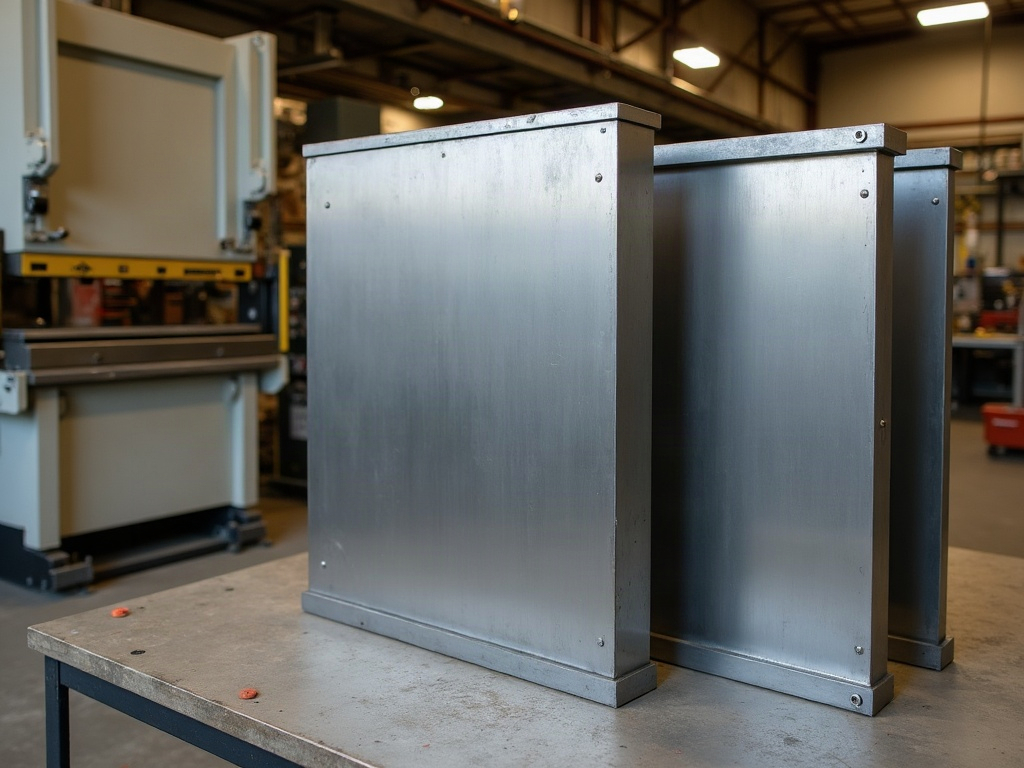
Custom Column Covers & Post Wraps: Metal Fabrication for Builders
Clean, snap-tight metal cladding for structural posts and columns — how to spec and order it so it wraps square, hides the seam and installs in minutes.
A column cover (or post wrap) is a formed metal sleeve that clads a structural post — a steel column, a glulam, a built-up wood post or a concrete-filled pipe — to give it a finished architectural face without the maintenance of paint or the swelling and checking of a wood wrap. You see them on storefronts, entry canopies, gas-station and drive-thru canopies, covered walkways, pavilions and the porch posts on higher-end residential work. The job of the cover is simple to describe and easy to get wrong: it has to wrap the post square, hold its line for the full height, and close up so the seam nearly disappears. This guide is written for builders, GCs and exterior crews who want covers fabricated to the actual post rather than trimmed and caulked out of stock coil on site.
Snap-lock, hemmed-seam, and two-piece covers
There are a few ways to close a cover around a post, and the right one depends on access and how the seam will be seen. A snap-lock cover is formed with a male and female return that snap together down the vertical seam — no exposed fasteners, fast to install, and the standard choice for square and rectangular columns. A hemmed-and-riveted or lock-seam cover gives a tighter, more permanent closure where you want the seam to essentially disappear. For a post that can’t be lifted or slid over — an existing structural column, or one already tied into a beam — a two-piece (or clamshell) cover wraps from both sides and closes on one or two vertical seams. Tell us whether the post is accessible from the top before it’s framed in, and we’ll form the closure that fits how the cover actually has to go on.
The detail that decides the look: a column cover lives or dies on how square and straight it stays. Formed returns, hemmed edges and a consistent break down the full length are what keep the faces flat and the seam tight; a cover bent freehand telegraphs every waver in the metal. Give us the finished dimensions and the height, and we’ll form it to hold its line top to bottom.
Why a custom cover beats a stock wrap kit
Off-the-shelf wrap kits come in a handful of fixed sizes, which means you’re either padding out the post to fit the kit or living with a loose, rattling cover and a fat caulk line. Custom fabrication lets you form the cover to the real post dimension, in the profile, gauge and finish that match the rest of the exterior package, and in the length you actually need instead of a stacked set of short sections. On substrate and gauge the same logic applies as the rest of your metal — our metal gauge guide covers where a taller, more exposed cover wants a heavier gauge to stay flat, and the aluminum vs. steel guide helps you pick the substrate for the climate and the finish you’re matching.
How to spec a column cover
A cover is quotable once we know the post and how the cover has to go on it. Give us the finished cross-section you want — the face dimensions of the square or rectangle, or the diameter for a round cover — and the overall height, noting whether it runs slab-to-beam or stops short at a base and cap. Tell us the number of faces and whether corners should be a crisp broken corner or a small radius. Say whether the post is accessible from the top (slide-over) or has to be a two-piece wrap, and call out anything the cover has to clear — a bracket, a light, a handrail tie-in. Note the substrate and gauge, the finish or color, and whether you want a formed base trim and top cap to close the ends. If you’re matching existing metal, a photo and a couple of tape measurements get us most of the way there — turning that into a clean fabrication drawing is exactly what our guide to spec’ing custom trim & flashing walks through.
Corners, caps and the details that show
On a column cover the eye goes straight to the corners and the ends, so those are the details worth getting right on the drawing rather than in the field. Broken corners want a consistent radius or a clean brake so all four edges read the same; a wrapped or mitered corner hides the seam better than a face-applied trim. At the base, a formed base trim or reveal closes the gap to the slab and gives a clean line to caulk to, and at the top a cap or a scribed cut ties the cover into the beam or soffit above. Where a cover meets a ceiling or canopy, it terminates into trim rather than being cut tight and caulked. Send us the top and bottom conditions with the post dimensions and we’ll form the caps, base trims and closures to match, so the parts that show aren’t being improvised on a ladder.
Lead time, quantities and getting it to the jobsite
Lead time depends on the number of covers, the height, the number of formed caps and base trims, and the finish. A run of identical square covers in a stock color moves faster than a mixed set of heights with custom Kynar color and two-piece wraps, so tell us the count, the sizes, the closure type, the finish and your need-by date up front — we’ll tell you straight whether that date is workable rather than promise it and miss. Covers ship in full lengths where the height allows, batched with their caps and base trims and labeled by location so your crew can set them post by post instead of sorting a pile on the deck.
Quick pre-send checklist
- Finished cross-section — face dimensions (square/rectangular) or diameter (round).
- Overall height per cover, and whether it runs slab-to-beam or base-to-cap.
- Closure type — slide-over snap-lock, lock-seam, or two-piece (clamshell) for an existing post.
- Ends — base trim and top cap, or how the cover terminates into slab, beam or soffit.
- Quantity and the count of each size, plus any obstructions the cover must clear.
- Material (steel with gauge, or aluminum with thickness), finish/color, and need-by date.
Made in Ogden and shipped nationwide, we fabricate custom metal column covers and post wraps — snap-lock, lock-seam and two-piece — with matching base trims and caps, formed to the real post so they wrap square and close tight. Send your dimensions, heights and closure type, and we’ll price it fast, flag anything that won’t wrap or seam cleanly, and build covers that set straight the first time.
Have posts to wrap?
Send your post dimensions, heights and closure type — we’ll fabricate column covers that wrap square and seam tight.