Kynar/PVDF vs. SMP Finishes
What the two most common paint systems on architectural metal actually deliver — and how to spec the right color and coating for custom fabrication.
Gauge and profile get most of the attention on a fabrication order, but the finish is what your client sees for the next few decades — and it’s where the biggest quality-vs.-cost trade-off lives. Nearly every piece of prefinished architectural steel you’ll spec is coated with one of two paint systems: a PVDF (Kynar 500®/Hylar 5000®) fluoropolymer or a silicone-modified polyester (SMP). They look similar in the sample chip and can differ meaningfully in the field. This guide breaks down what each system does well, where each fits, and exactly what to tell us so your custom trim, flashing and panels come back in the right color and coating the first time.
What a coated metal system is made of
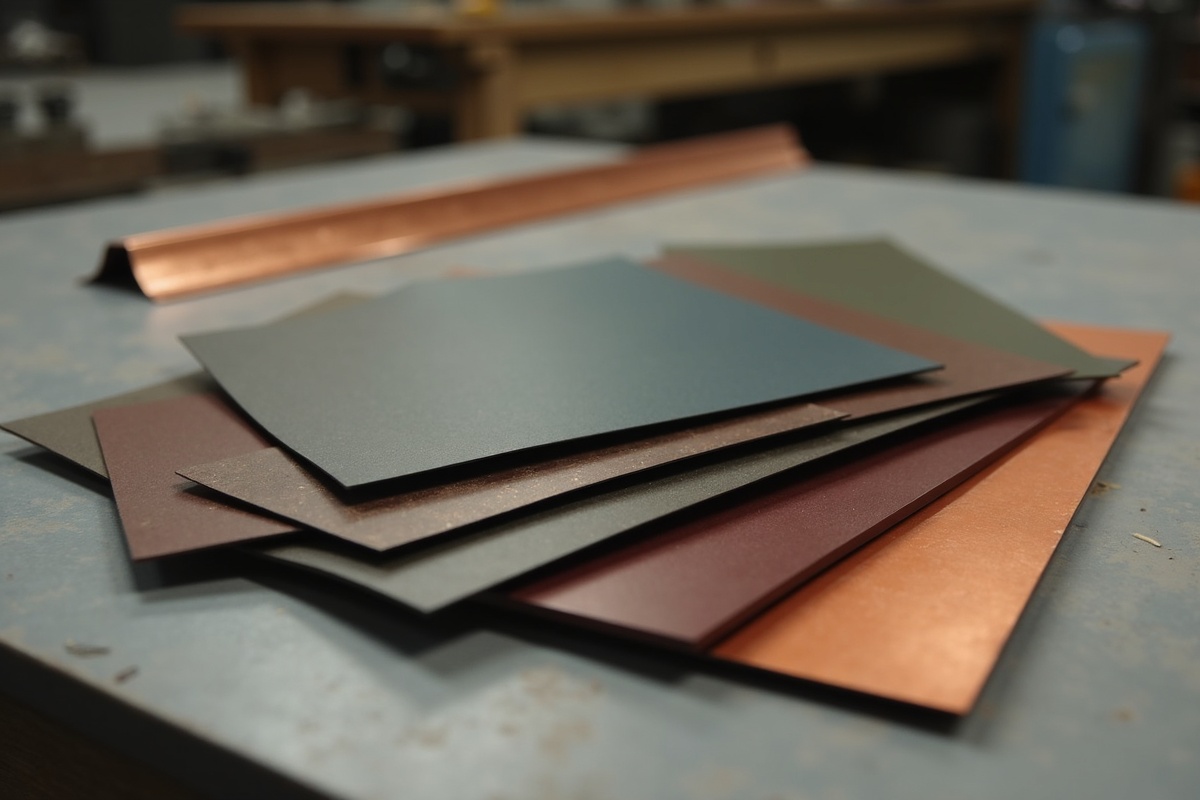
Prefinished architectural metal is a stack, not just a color. Underneath the paint is a metallic-coated steel substrate — typically galvanized or Galvalume® — then a primer, then the topcoat that gives the panel its color and does the weathering work. When people say “Kynar” or “SMP,” they’re talking about the resin in that topcoat. Aluminum can carry the same paint systems, but it’s measured in decimal thickness rather than gauge — our aluminum vs. steel guide covers when to choose each substrate. The finish rides on whatever base metal you spec, so the two decisions are linked.
PVDF / Kynar 500® — the architectural premium
PVDF (polyvinylidene fluoride) fluoropolymer coatings — sold under the Kynar 500® and Hylar 5000® resin brands — are the benchmark for long-term color and gloss retention. The fluoropolymer chemistry is exceptionally resistant to UV, so these finishes hold their color and resist chalking and fading far longer than lower-tier paints. That’s why PVDF is the standard call on commercial, institutional and higher-end residential architectural work, and why it typically carries the longest finish warranties in the category. The trade-offs are real: PVDF costs more per square foot, the color palette leans toward architectural tones, and the coating is somewhat softer than a hard polyester, so it wants careful handling during forming and install. When color longevity on a visible surface is the priority, PVDF is usually worth it.
SMP — the hard, cost-effective workhorse
Silicone-modified polyester sits a tier below PVDF on weathering but earns its place on price and toughness. SMP topcoats are harder and more abrasion- and scratch-resistant than PVDF, which can be an advantage on pieces that take handling abuse. They’re also noticeably cheaper, which matters on large-quantity or budget-driven jobs. The trade-off is UV performance: SMP finishes will generally chalk and fade sooner than a fluoropolymer, especially in bright, high-exposure climates and on darker or more vivid colors, which tend to show fade fastest. For agricultural buildings, outbuildings, and cost-sensitive residential where a shorter finish life is acceptable, SMP is a sound, honest choice.
Quick rule of thumb: spec PVDF/Kynar when long-term color retention on a visible surface drives the job, and SMP when up-front cost and surface hardness matter more than decades of fade resistance. On darker and brighter colors, the gap between the two systems tends to widen — the more saturated the color, the more a fluoropolymer earns its premium.
Color, gloss and matching
Both systems come in wide standard palettes, and both offer low-gloss options — architectural work usually favors a lower sheen because it hides minor oil-canning and reads cleaner on large surfaces. When you’re fabricating trim, flashing or accessories to tie into an existing panel run, the finish system, color name and gloss all need to match the panel, not just the color. Two chips can look identical in hand and still differ in gloss or weather differently if one is PVDF and the other SMP. If you need a match to something already on the building, send us the manufacturer and color name if you have it, or a physical sample — specifying the exact system and color name up front avoids a mismatch that only shows up after install.
How to spec finish when you order
Finish is one line on a complete order, and it works best alongside the rest of the spec. When you send a request, include:
- Substrate & thickness: steel (with gauge) or aluminum (with decimal thickness). See our metal gauge guide if you’re deciding between 22, 24 and 26.
- Finish system: PVDF/Kynar 500® or SMP — state which, don’t just give a color.
- Color name & gloss: the manufacturer color name if matching an existing system, plus gloss level if it matters.
- Profile, dimensions, quantities and lengths: the same drawing-and-dimensions detail from our guide to spec’ing custom trim & flashing.
If you’re not sure which system fits, tell us the application, the exposure and the budget, and we’ll recommend a finish we can stand behind rather than quoting one we can’t. Made in Ogden and shipped nationwide, we brake- and roll-form custom architectural metal in both PVDF and SMP finishes to match the system your job is built around. Send us your profile, substrate and color, and we’ll price it fast.
Need a finish matched to your panel?
Send the color name, system and profile — we’ll match the coating and price it live.