
Custom Pitch Pans & Pitch Pockets for Roof Penetrations: Fabrication for Roofing Crews
The metal pocket that seals the odd-shaped roof penetration a boot or collar can’t — how to spec the pan, flange and hood so the fill stays watertight and stays maintainable.
A pitch pan — also called a pitch pocket or pourable-sealer pocket — is a small open-top metal box or collar that fits around a roof penetration a standard boot or flashing can’t seal. When something odd comes through the roof — an angle-iron brace, a cluster of conduit, a structural strut, a sign-support leg, a bundle of small pipes — there is no round pipe boot that fits it. The pan surrounds the penetration, ties into the roof system with a flange, and is then filled with a pourable sealer that locks around the irregular shape. This guide is written for roofing crews, GCs and sheet-metal shops who want pitch pans fabricated to the actual penetration and roof type rather than cobbled from a stock can on the roof.
When you actually need a pitch pan
A pitch pan is a last-resort detail, and the honest guidance from the industry is to avoid it when a better flashing exists. A single round pipe is better served by a boot or a soldered collar; a square curb is better served by a fabricated curb flashing. Reach for a pan when the penetration is irregular, multiple, or structural — the shape simply can’t be wrapped by a one-piece flashing. Because a filled pan depends on a sealant that will not last as long as the metal around it, the right pan is one designed to be inspected and re-topped, not sealed once and forgotten. We fabricate to that reality: a clean metal pocket you can maintain, with a flange that integrates into the roof like any other flashing.
The detail that decides whether it lasts: the fill is the weak point, not the metal. A deep pan filled flush with a single pour cracks, ponds and leaks within a few seasons. The pans that hold up are built for a two-stage fill — a non-shrink grout or sealant base, topped with a flexible pourable sealer crowned to shed water — and often capped with an umbrella hood so sun and standing water never hit the sealant directly. Tell us how the pan will be filled and we size the depth and add the hood so it can be maintained.
The anatomy: walls, base flange, hem and hood
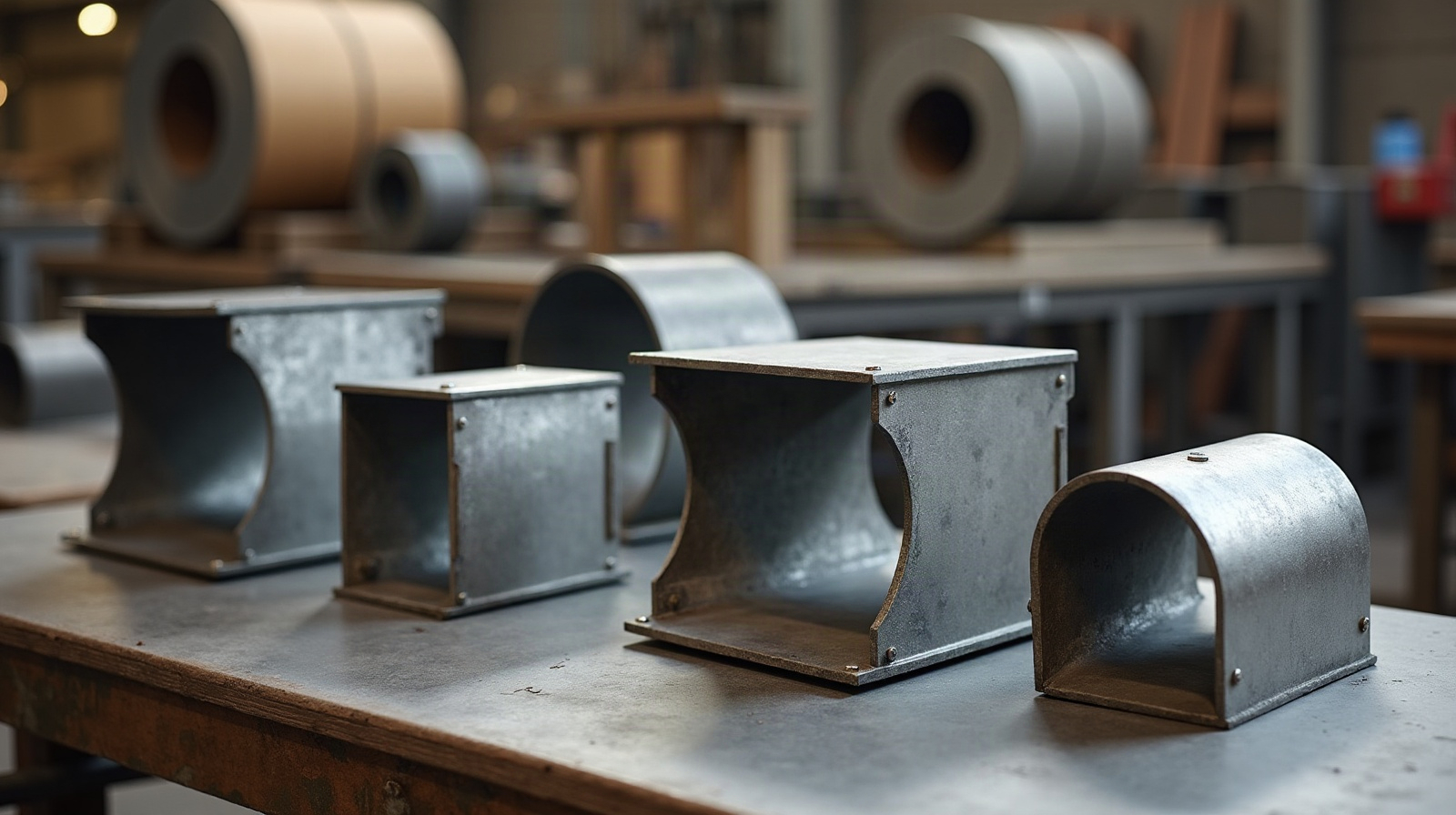
A pitch pan is a few simple parts formed into one pocket. The walls form the open box or collar around the penetration, sized to leave working clearance on all sides so sealer can flow fully around the shape. The base flange runs out flat from the bottom of the walls and is what ties the pan into the roof — it gets stripped in, counterflashed, or set into the membrane like any other flashing flange. We can form a hemmed top edge to stiffen the rim and remove the raw cut, and add a sloped umbrella hood or collar over the top that sheds water off the fill. On metal and soldered work the corners are lapped and soldered or welded watertight rather than just folded. Tell us which parts you need and how deep, and we build the pan in one piece.
Shapes: round, square, rectangular and multi-penetration
Pans are fabricated to the penetration, not pulled from a shelf. A round pan suits a single post or pipe that still needs a pourable seal; a square or rectangular pan suits angle iron, tube steel or a small equipment leg; a multi-penetration pan is one larger pocket sized to surround a cluster of conduit or several small pipes that come through close together, which is far more watertight than crowding three separate pans. We can also form slotted or notched walls where a continuous member passes through the pan. Give us the number, size and spacing of the items coming through and we form a pocket that leaves fill clearance around every one.
Tying the flange into the roof system
The flange is where a pan succeeds or leaks, and it has to match the roof it lands on. On a membrane roof (TPO, EPDM, PVC) the flange is set and the membrane stripped or welded over it. On a metal or soldered roof the flange is soldered or sealed and lapped under the surrounding metal so water sheds over, not under, it — the same roof-to-wall logic covered in our counterflashing & reglet guide. On a shingle roof the flange laps the courses below and tucks under the courses above. Tell us the roof type and we form the flange width and finish to integrate, instead of leaving a proud box caulked to the surface.
How the fill works — and keeping it maintainable
The pan is the container; the pourable sealer is what actually seals around the irregular shape. The durable approach is a two-stage fill: a non-shrink base brings the pocket up most of the way, then a flexible, UV-stable pourable sealer is poured on top and crowned so it sheds water toward the flange rather than ponding. Because that top layer is the part that ages, the pan should be built so a crew can scrape and re-pour the top during routine maintenance without disturbing the flange. An umbrella hood clipped or formed over the pan keeps direct sun and standing water off the sealant and buys years. We don’t supply the sealant, but we size and detail the pan so the fill specified for the job can be installed and maintained.
Material, gauge and finish
Match the pan to the roof metal and the exposure. Galvanized or coated steel is economical and stiff; aluminum is light and won’t rust; copper and stainless suit soldered, high-end and long-service work. Because a pan holds a column of sealer and sometimes a hood, it benefits from a stiffer gauge than light trim — the right choice follows the same logic as our metal gauge guide, and the substrate trade-offs are in the aluminum vs. steel guide. Tell us what the surrounding roof and flashings are and we match the coil so the pan reads as part of the system, not a patch.
Spec’ing a pitch pan order
A pitch pan is quotable once we know the penetration and the roof. Give us the shape, size and number of items coming through and their spacing, the pan depth you need for the fill, and the roof type so the flange integrates. Call out the material, gauge and finish, whether you want a hemmed rim, an umbrella hood, and soldered or welded corners for a fully watertight box. A dimensioned sketch of the penetration and the surrounding roof gets us most of the way — turning that into a clean fabrication drawing is exactly what our guide to spec’ing custom trim & flashing walks through.
Lead time, lengths and getting it to the jobsite
Pitch pans are small parts, but the details drive the lead time: the number of distinct shapes, whether corners are soldered or welded, and whether hoods are added. We fabricate each pan to its penetration, solder or weld the corners watertight where specified, mark each pan to its location so your crew sets the right pocket on the right opening, and box them protected so flanges and hoods arrive flat and true. Made in Ogden and shipped nationwide, custom pitch pans leave the shop ready to set, strip in and fill.
Quick pre-send checklist
- Penetration shape & count — round post, angle iron, tube steel, or a cluster of conduit/pipes, with spacing.
- Pan size & depth — clearance around every item plus depth for the fill specified.
- Roof type — membrane (TPO/EPDM/PVC), metal/soldered, or shingle, so the flange integrates.
- Hood & rim — umbrella hood to protect the fill, hemmed top edge, soldered/welded corners.
- Material (steel with gauge, aluminum, copper or stainless) and finish/color to match the roof.
- Quantities and need-by date.
Made in Ogden and shipped nationwide, we fabricate custom pitch pans and pitch pockets — walls, base flange, hemmed rim and umbrella hood — sized to your penetration and formed to tie into your roof system, in the substrate, gauge and finish that match the rest of your metal. Send the shape and count of what’s coming through, the depth you need and the roof type, and we’ll price it fast, flag where a dedicated flashing would beat a pan, and build a pocket you can seal once and still maintain.
Sealing an odd penetration?
Send the shape and count of what’s coming through, the depth you need and the roof type — we’ll fabricate a pitch pan with the flange, rim and hood formed to tie in and stay watertight.