
Skylight & Roof-Curb Flashing: Custom Fabrication for Roofing Crews
The metal that keeps a curb-mounted skylight or roof curb watertight — how to spec the base, head, sides and cricket so the flashing laps the roof the right way and never dams water.
A skylight or roof penetration mounted on a curb — a raised box that lifts the opening above the plane of the roof — only stays dry because of the metal wrapped around it. That metal is the curb flashing set: the pieces that tie the curb into the roof so water runs down past it instead of into it. On a shingle or low-slope roof the set is usually a base (apron) at the downslope side, step or side pieces up the slope, a head flashing across the top, and — on wider curbs — a cricket behind it to split the flow. This guide is written for roofing crews, GCs and architects who want curb flashing fabricated to the actual curb and roof profile rather than field-cut and caulked on the deck.
The pieces of a curb flashing set and how they lap
Think of the set as a shingle course in metal: every piece has to lap over the one below it so water is always handed downhill. At the bottom (downslope) edge sits the base or apron, which laps out onto the roof and up the face of the curb. Up the two sides run step or pan pieces that weave into the roofing course by course or run as a continuous pan, lapping the base at the corner. Across the top (upslope) edge is the head flashing, which tucks under the roofing above and over the side pieces. Get the lap order right and the curb sheds water the way a roof does; reverse any one lap and you have built a dam. We fabricate each piece to length so the laps land where they should instead of being trimmed to fit.
The detail that decides whether it works: the upslope side. Water coming down the roof hits the back of the curb first, so the head flashing — and, on anything but a narrow curb, a cricket — is where leaks start. Tell us the curb width and the roof pitch and we’ll build a cricket that splits the flow cleanly around both sides instead of letting it pond and find the seam.
The cricket (saddle) behind the curb
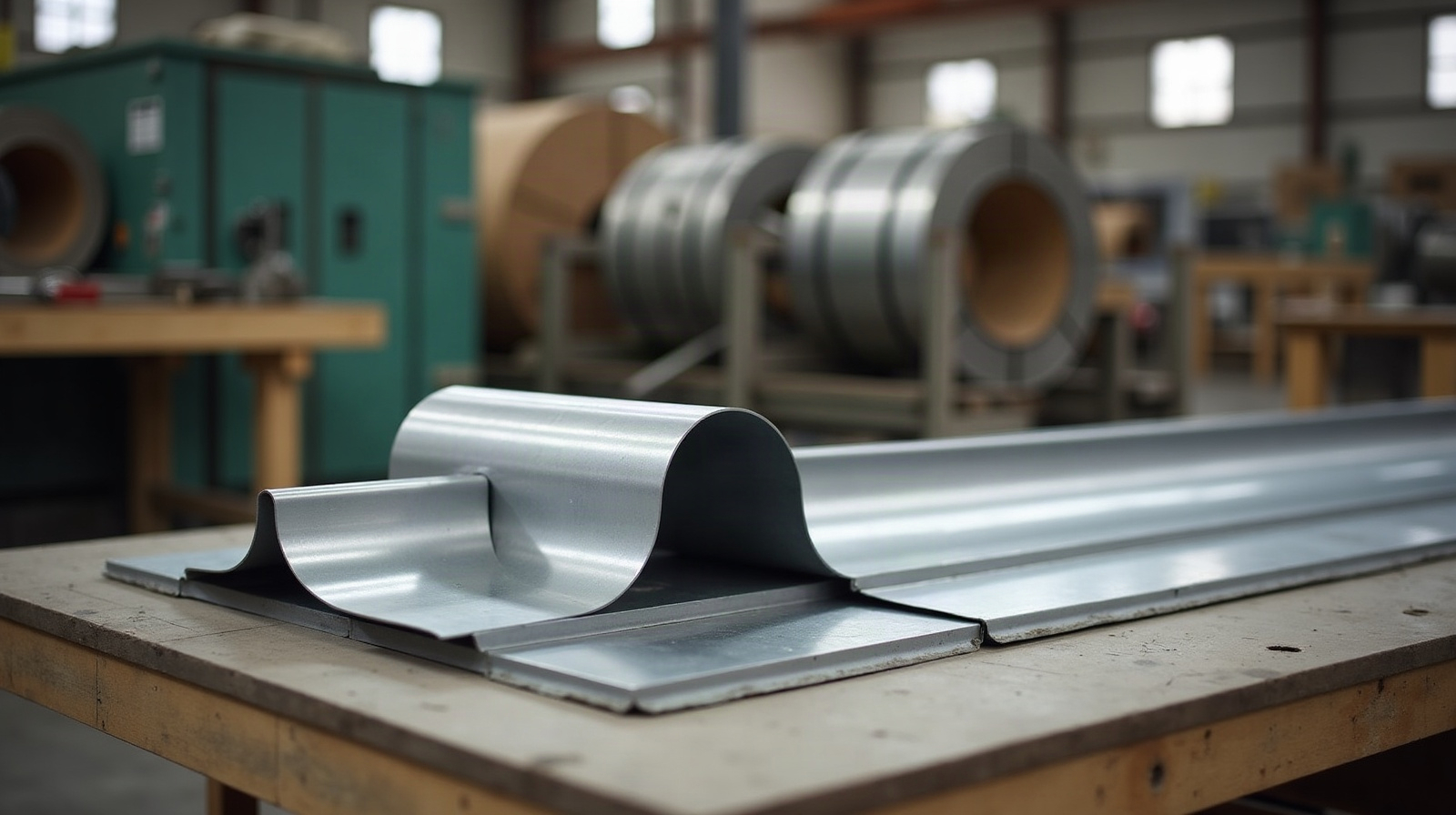
A cricket, or saddle, is the small ridged diverter fabricated behind the upslope side of a curb to break the water into two streams and send it around the box. The wider the curb and the shallower the pitch, the more it needs one — a narrow curb on a steep roof may shed fine with head flashing alone, while a wide curb across the slope will pond behind it without a cricket. We form crickets as a folded metal saddle sized to the curb width and the roof pitch, with the legs long enough to lap the side flashings. Give us the curb width and the pitch and we’ll build the saddle to divert, not dam; the same flow-splitting logic we bring to custom valley & W-valley flashing.
Standing seam vs. exposed-fastener and shingle roofs
How the flashing meets the field changes with the roof. On a standing seam roof the side pieces usually run as pans that die into the ribs, and the head flashing has to clear the rib height, so we need the profile and seam height to form a piece that sits flat. On an exposed-fastener panel roof the flashing follows the rib pitch and is fastened and sealed at the laps. On shingles or shakes the base and steps weave into the courses in the traditional step-flashing pattern. Tell us the roof type and panel profile and we fabricate the set to tie into it rather than sit proud of it.
Spec’ing a curb flashing set
A curb set is quotable once we know the box and the roof. Give us the curb dimensions (length × width × height above the deck), the roof pitch, and the roof type and panel profile so the laps and cricket are sized right. Call out the material, gauge and finish — the gauge logic is the same as our metal gauge guide, and the substrate choice follows the aluminum vs. steel guide. Note whether exposed edges want a hemmed lip, whether corners are soldered (copper or stainless) or sealed and riveted (aluminum/steel), and whether the skylight has its own cap that the curb flashing laps under. A dimensioned sketch gets us most of the way; turning that into a clean fabrication drawing is exactly what our guide to spec’ing custom trim & flashing walks through.
Material, finish and matching the rest of the metal
Curb flashing sits in plain view on the roof and the water is always working it, so the material matters. Aluminum is light and won’t rust; galvanized or coated steel is economical and strong; copper and stainless take a soldered seam and age well on higher-end work. Match the finish and color to the rest of your roof metal so the curb reads as part of the roof, not a patch bolted onto it — the same discipline we bring to roof-to-wall counterflashing elsewhere on the same building. Tell us what the panels, ridge and trim are and we’ll match it.
Lead time, quantities and getting it to the jobsite
Curbs tend to repeat on commercial jobs — a row of identical skylights or units — while custom one-offs are common on homes, and the two drive the schedule differently. What moves lead time is the number of distinct curb sizes, whether corners are soldered, the finish, and whether crickets are involved. A run of identical sets in a stock color moves fast; a set of soldered copper curbs with crickets takes longer, so give us the quantities and sizes up front and we’ll quote a straight date rather than promise one and miss. We label pieces by curb location and box them in order so your crew installs off a marked bundle instead of sorting look-alike parts on the roof. Made in Ogden and shipped nationwide, curb flashing ships protected so the hems, folds and soldered corners arrive true.
Quick pre-send checklist
- Curb dimensions — length × width × height above the deck, and how many of each.
- Roof pitch and whether the curb needs a cricket behind it.
- Roof type & panel profile — standing seam (with seam height), exposed-fastener, or shingle/shake.
- Lap intent — base, sides, head, and whether the skylight cap laps over the head flashing.
- Edges & corners — hemmed lips, soldered or sealed corners.
- Material (steel with gauge, aluminum, copper or stainless) and finish/color to match your roof, plus need-by date.
Made in Ogden and shipped nationwide, we fabricate custom skylight and roof-curb flashing — base, sides, head and cricket — formed to your curb size, roof pitch and panel profile, in the substrate, gauge and finish that match the rest of your metal. Send your curb dimensions, pitch and roof type, and we’ll price it fast, flag any lap that won’t shed cleanly, and build a set that keeps the curb dry the first time.
Curb to flash?
Send your curb dimensions, roof pitch and panel profile — we’ll fabricate a base, head, sides and cricket that lap the roof the right way.