
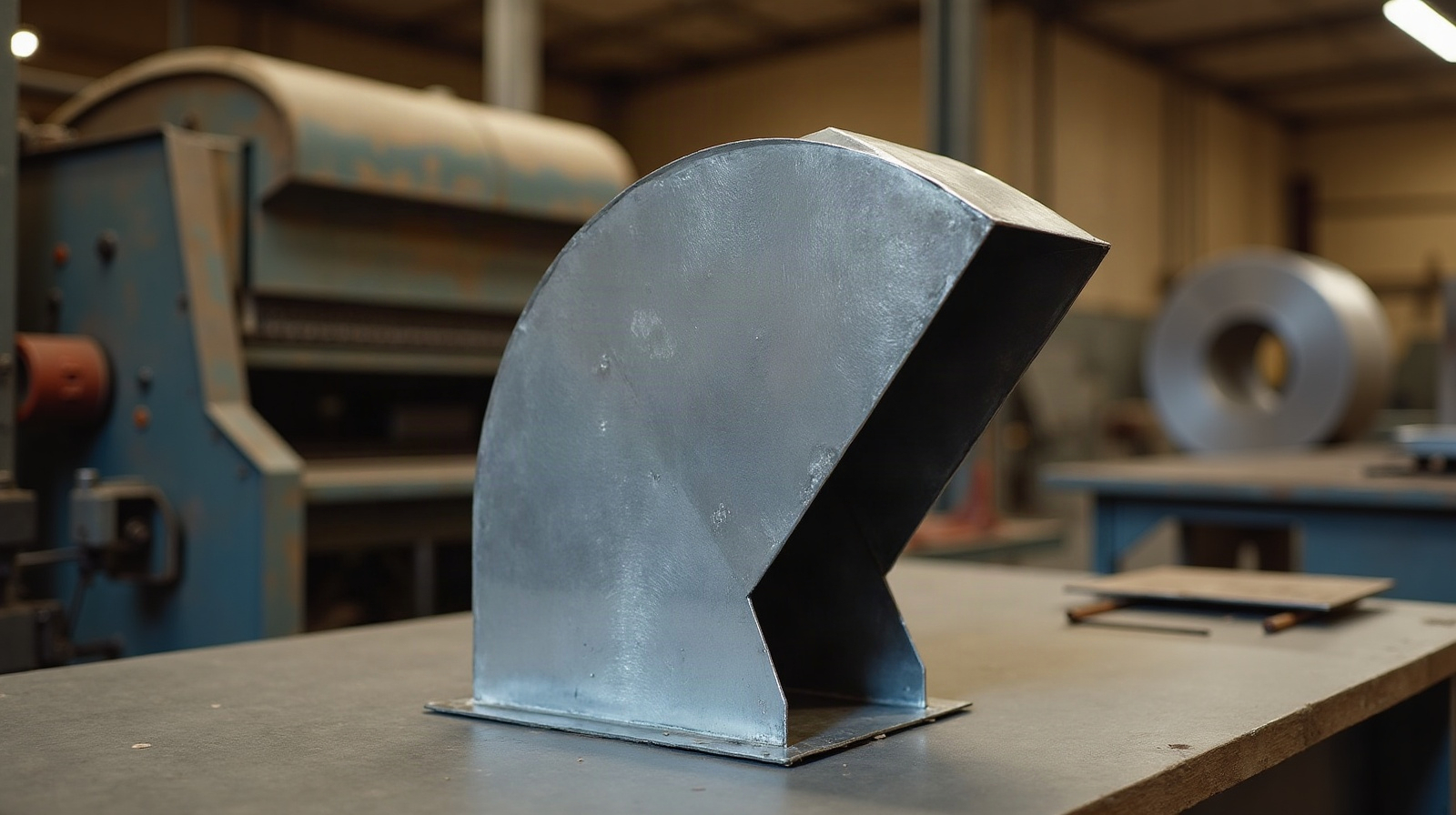
Custom Metal Crickets & Saddles for Chimneys and Curbs: Fabrication for Roofing Crews
The peaked diverter that splits water around the upslope side of a wide chimney or curb — how to spec the ridge, pans and flanges so nothing ponds, piles or leaks behind it.
A cricket — also called a saddle — is a small peaked structure fabricated to sit on the upslope side of a chimney, a wide curb or any obstruction that crosses the flow of a sloped roof. Left alone, the uphill face of a wide chimney acts like a dam: water, ice and debris pile against the back of it, pond, and eventually find their way through the flashing. A cricket replaces that flat dam with a ridge that splits the flow and two sloped pans that carry water and debris around the obstruction to either side. This guide is written for roofing crews, GCs and sheet-metal shops who want crickets and saddles fabricated to the actual chimney, curb and roof pitch rather than framed and wrapped on the roof.
When a chimney or curb needs a cricket
The rule of thumb most crews work to — and what the building codes generally call for — is a cricket whenever a chimney or curb is wider than about 30 inches measured across the slope. Narrower than that and a well-made back pan with enough upslope leg can shed water on its own; wider than that and the back of the obstruction collects too much water and debris to drain reliably, so a diverter is needed. Beyond width, reach for a cricket any time you see the tell-tales of a missing one: staining, rot or ponding behind a chimney, debris packed against the uphill face, or ice building there every winter. Tell us the width of the obstruction and the roof pitch and we will tell you whether a back pan is enough or a full cricket is the right call.
The detail that decides whether it works: the ridge has to actually shed. A cricket built too flat — or set so its ridge runs the wrong way — still ponds and defeats the point. The crickets that last are fabricated with a ridge pitched steeply enough to drain, sloped pans that die cleanly into the roof plane on each side, and a back pan tall enough to carry up behind the counterflashing. Give us the obstruction width and the field pitch and we lay out the ridge height and pan slope so water leaves, every time.
The anatomy: ridge, sloped pans, back pan and flanges
A cricket is a few formed parts joined into one diverter. The ridge runs from the back of the obstruction up the slope to a peak, the high line that splits the flow. Two sloped pans fall away from that ridge to each side and carry water around the chimney into the field. The back pan (or head flashing) rises up the uphill face of the obstruction and tucks behind the counterflashing so nothing runs behind it. Flat base flanges run out from the bottom of the pans and lap into the surrounding roof like any other flashing. On metal and high-end work the corners and the ridge seam are lapped and soldered or welded watertight rather than just folded and caulked. Tell us which parts you need formed as one piece and we build the saddle to drop over the obstruction and tie in.
Sizing: width, roof pitch and ridge height
A cricket is laid out from three numbers: the width of the obstruction across the slope, the roof pitch, and the cricket slope you want on the pans. The wider the chimney, the farther up the roof the ridge has to run and the taller the back pan climbs, so the whole saddle grows with the obstruction. A steeper field pitch lets the pans shed with a shorter ridge; a low-slope roof needs a more deliberate ridge height and sometimes a flatter, wider saddle. We draw each cricket to the obstruction and field pitch you give us so the pans die into the roof plane cleanly and the back pan carries high enough — give us the width, the pitch and how the obstruction sits and we handle the geometry.
Chimneys, wide curbs and skylights
The same saddle logic covers more than masonry chimneys. A masonry or metal chimney gets a cricket on its uphill face tied to counterflashing; a wide rooftop curb or skylight that spans the slope needs the same diverter so water does not pool on its uphill side. Where the obstruction is a curb we form the cricket to match the curb height and its curb flashing so the two read as one assembly. The difference between the cricket and the wall tie-in matters: the cricket is the diverting structure that sheds water around the obstruction, while the counterflashing and reglet detail is how the back pan seals to the masonry above it. Tell us the obstruction type and we fabricate the cricket and its tie-in to work together.
Tying the flanges into the roof system
A cricket succeeds or leaks at its edges, and the flanges have to match the roof they land on. On a shingle or metal-panel roof the side flanges lap under the courses or panels above and over those below so water sheds over, not under, the saddle. On a membrane roof (TPO, EPDM, PVC) the flanges are set and the membrane stripped or welded over them. The back pan always carries up behind the counterflashing on the uphill face. We form the flange widths, hems and finish to integrate with the roof you are running instead of leaving a proud diverter caulked to the surface — tell us the roof type and we match it.
Material, gauge and finish
Match the cricket to the roof metal and the exposure. Galvanized or coated steel is economical and stiff; aluminum is light and will not rust; copper and stainless suit soldered, high-end and long-service work. Because a saddle spans an opening and takes the load of sliding snow and debris, it benefits from a stiffer gauge than light trim — the right choice follows the same logic as our metal gauge guide, and the substrate trade-offs are in the aluminum vs. steel guide. Tell us what the surrounding roof and counterflashing are and we match the coil so the cricket reads as part of the system, not a patch.
Spec’ing a cricket or saddle order
A cricket is quotable once we know the obstruction and the roof. Give us the width of the chimney or curb across the slope and its depth, the roof pitch, and how the obstruction sits in the field. Call out the material, gauge and finish, whether you want the ridge and corners soldered or welded watertight, and how the back pan ties to the counterflashing above. A dimensioned sketch of the chimney and the surrounding roof gets us most of the way — turning that into a clean fabrication drawing is exactly what our guide to spec’ing custom trim & flashing walks through.
Lead time, lengths and getting it to the jobsite
Crickets are not shelf parts — each one is laid out to an obstruction and a pitch, so the details drive the lead time: the width and pitch, whether the ridge and corners are soldered or welded, and whether it ships as one piece or in sections for a large chimney. We fabricate each saddle to its chimney or curb, solder or weld the ridge and corners watertight where specified, mark each one to its location so your crew sets the right saddle on the right obstruction, and box them protected so ridges and flanges arrive straight and true. Made in Ogden and shipped nationwide, custom crickets leave the shop ready to set, lap in and counterflash.
Quick pre-send checklist
- Obstruction width & depth — chimney or curb size across and up the slope (the 30-inch-wide rule is the usual trigger).
- Roof pitch — field slope, so the ridge height and pan slope shed cleanly.
- Roof type — shingle, metal panel, or membrane (TPO/EPDM/PVC), so the flanges integrate.
- Back pan & tie-in — height up the uphill face and how it meets the counterflashing.
- Material (steel with gauge, aluminum, copper or stainless) and finish/color to match the roof.
- Quantities and need-by date.
Made in Ogden and shipped nationwide, we fabricate custom metal crickets and saddles — ridge, sloped pans, back pan and flanges — laid out to your chimney or curb width and roof pitch, and formed to tie into your roof system in the substrate, gauge and finish that match the rest of your metal. Send the obstruction width, the roof pitch and the roof type, and we’ll price it fast, tell you whether a back pan or a full cricket is the right call, and build a diverter that sheds water around the chimney and stays watertight.
Water piling behind a chimney?
Send the obstruction width, the roof pitch and the roof type — we’ll fabricate a cricket with the ridge, pans and back pan formed to shed water around it and tie in watertight.